
This article was originally published in Property Week’s Student Accommodation supplement, December 2025.
Innovation is one of those sector words that can mean everything or nothing, depending on how generously it’s used. That’s why winning Interior Design of the Year last week — for a concept recognised for its adaptability and wellbeing potential — felt significant. Nestblok may technically be only a year old, but the analysis and conversations behind it have been building quietly for much longer. The real turning point came when, in collaboration with LOFT and informed by research from The Property Marketing Strategists, we decided to stop repeating the familiar PBSA bedroom formula and instead design the student room of tomorrow. Not as a theoretical exercise, but as a response to years of seeing the same safe, functional layouts replicated again and again, even as student needs continued to shift.
What listening revealed
The earliest spark for Nestblok came from student insights shared by The Property Marketing Strategists. Two seemingly simple requests appeared again and again:
- “More storage.”
- “More opportunities to personalise the bedroom.”
Traditionally, the sector has approached these with standard answers: oversized pinboards, ottoman beds that are prone to piston failures, or under-bed openings at the back that are awkward to reach. When we looked closely, we realised students weren’t asking for extravagance — they were asking for ease and ownership.
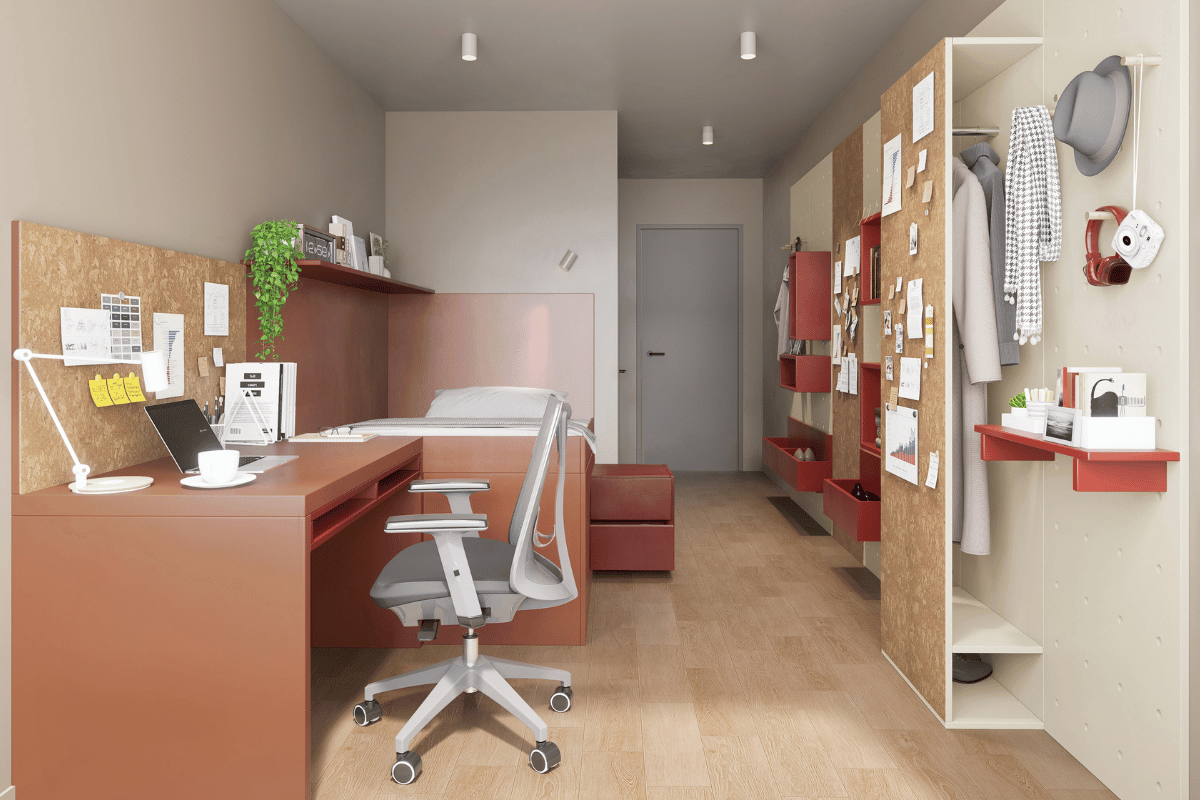
So we combined those two needs into one idea: a modular system where every inch under the bed is accessible through smooth pull-outs, no heavy lifting, no wrestling with mattresses. What surprised us was the sense of play it created. Watching someone test the prototype for the first time, sliding out each component, it changed the atmosphere of the room immediately. The space felt more intuitive, and somehow more theirs.
Another comment — this time about desks — pushed our thinking again. Students told us that if a friend comes to study in their room, there’s nowhere to sit except the bed. A simple detail, but it reveals how some students actually use their space. We had already explored furniture that could move rather than be fixed, so the pull-out storage cube on casters became one example of many. Not a perfect solution, but a reminder: we can’t predict every scenario. That’s exactly why flexibility must be built in from the start.
This is the real lesson Nestblok taught us. Not every feature needs to be definitive; sometimes the best thing you can offer students is the ability to adapt the room to whatever the day requires.
Taking risks when projects won’t let you
This level of experimentation is only possible when partners are able — and willing — to take risks. For Nestblok, that responsibility sat squarely with LOFT and A Designer at Heart. We invested design time; they invested manufacturing capacity. Neither of us knew exactly where the project would land. There was no client brief, no guaranteed outcome, no commercial safety net. Just a shared sense that the standard PBSA bedroom wasn’t keeping up with the realities of how students live.
That freedom mattered, because live projects rarely allow this kind of exploration. Cost plans tighten, H&S concerns flatten ambition, and even the smallest departure from the safe, known spec can feel risky when you’re responsible for delivering on time and on budget. There’s nothing wrong with that — it’s the developer’s job to manage risk — but it does mean that genuine innovation often has no natural home.
Nestblok only became real because we frontloaded the risk and created that space for ourselves. When the prototype was finally revealed, the response was immediate. People understood it without explanation. The simplicity of it — storage that works, components that move, a framework that can evolve — made sense.
What the event revealed about where PBSA is heading
Across conversations at the Property Week Student Accommodation Conference & Awards 2025, a few themes kept surfacing:
- Affordability is becoming an unavoidable priority. Developers are recognising that the sector cannot rely solely on premium products. There is a growing appetite for a more nuanced mix: social studios, small clusters, twoodios, and hybrid arrangements that broaden access without diluting quality.
- Flexibility is no longer optional. The fitted bedroom typologies of the last two decades won’t carry us through the next. Students want choice, and choice often has less to do with luxury than with usability.
- Amenity rooms need more purpose and less spectacle. There’s a quiet fatigue around over-amenitised buildings. A room only succeeds if it’s activated well. Even podcast rooms — dismissed by many during the event — can succeed brilliantly when designed and activated thoughtfully. It’s the intention that matters. These conversations don’t dictate what we design, but they shape our readiness. They remind us to keep questioning assumptions, and they validate the importance of having adaptable ideas in our back pocket — ideas we can develop with clients who want to explore new territory.
A thought to take forward
The PBSA industry is filled with people who care deeply about creating safe, supportive environments for students. But caring isn’t enough on its own; innovation happens when those priorities meet a willingness to reimagine the fundamentals.
Nestblok isn’t revolutionary in a technological sense. There is no complex engineering, no complicated mechanism. Its strength lies in its simplicity: thoughtful storage, modular components, mobility where it matters, and an openness to evolve over time.
If this year’s awards taught me anything, it’s that designing for students means designing for uncertainty — and embracing the moments when they show us what we’ve missed.
If you’re exploring how your next scheme might bring more flexibility into the room, I’d be very happy to continue the conversation.

Comments
latest


